


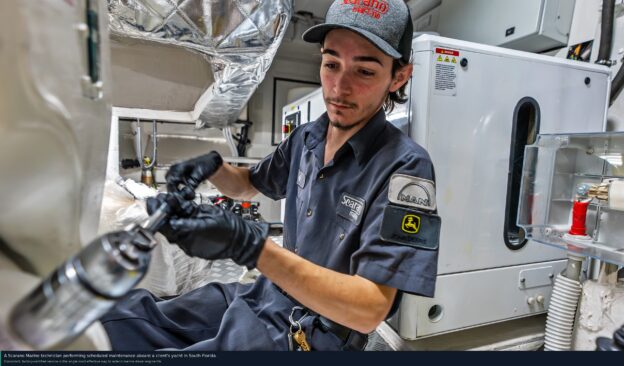
Extend marine diesel engine life in South Florida — that’s the goal of every maintenance decision you make as a yacht owner operating in this climate. Extending marine diesel engine life in South Florida comes down to eight proven practices: maintaining South Florida-adapted service intervals rather than manufacturer standard intervals, managing cooling system health proactively, replacing the raw water impeller on schedule, keeping the fuel system clean through regular filter changes and annual fuel sample testing, managing zinc anodes before they fully deplete, following proper turbocharger cool-down procedures, maintaining annual oil analysis, and scheduling factory-level EDC diagnostic scans. The difference between a MAN engine that reaches 6,000 hours and one that fails at 2,000 hours is almost entirely maintenance discipline — not luck.
South Florida is one of the most demanding marine environments in the world. The combination of heat, humidity, warm inshore water temperatures, and the sustained offshore running that Bahamas crossings and tournament season demand accelerates engine wear in ways that don’t apply in cooler climates. The good news is that every single one of these accelerants is manageable — with the right maintenance approach applied consistently. After more than 30 years servicing MAN marine diesel engines across Fort Lauderdale, Miami, and the Caribbean, I can tell you that long-lived engines are not lucky engines. They are well-maintained engines.
Why You Must Extend Marine Diesel Engine Life South Florida Differently Than Up North
MAN’s published service intervals are designed around standard operating conditions. Fort Lauderdale and Miami in July is none of those things. When the standard conditions your service intervals were designed around don’t match your actual operating environment, the standard intervals aren’t adequate protection.
South Florida-specific factors that accelerate wear beyond what manufacturer intervals account for:
- Ambient air temperatures above 90°F in summer: Reduces air density, increases thermal load on cooling systems, and narrows the margin between normal operation and the EMS protection threshold.
- Inshore water temperatures in the mid-80s: Warm raw water reduces cooling system efficiency — heat exchangers work harder, zincs deplete faster, and thermal margin is tighter under load.
- High humidity: Accelerates moisture accumulation in diesel tanks, drives microbial growth, and promotes saltwater corrosion on electrical connections and engine room components.
The solution is not to service more often across the board — it is to adjust the specific intervals and procedures that South Florida’s conditions stress most. That is exactly what the eight steps below address.
8 Proven Steps to Extend Marine Diesel Engine Life South Florida
1. Use South Florida-adapted service intervals, not manufacturer standard
The single most impactful thing a South Florida yacht owner can do to extend marine diesel engine life is to service more frequently than the manufacturer’s standard interval on the items most stressed by local conditions. Our standard recommendation for MAN engines in South Florida:
- Oil and filter change: Every 200 hours or annually — whichever comes first. Do not push to 400 hours in South Florida conditions.
- Fuel filters: Every 200 hours. South Florida’s warm diesel tanks accelerate microbial growth and fuel degradation.
- Raw water impeller: Annually.
- Heat exchanger service: Every 2 years— earlier than manufacturer standard in South Florida’s mineral-rich inshore water.
Our complete South Florida MAN engine maintenance schedule covers every interval in detail.
2. Manage cooling system health proactively — not reactively
More MAN engines in South Florida fail from cooling system neglect than from any other single cause. The plate heat exchanger, raw water circuit and thermostat all work together to keep the engine in its thermal operating range. When any one of them degrades, the whole system loses margin — and that lost margin is what shows up as EDC power de-rating on a summer tournament day or as overheating offshore.
Proactive cooling system management means descaling the heat exchanger on schedule before efficiency drops, replacing the thermostat proactively if there is any history of temperature fluctuation, and never allowing zincs to fully deplete. The cost of proactive cooling system maintenance over 5,000 hours is a fraction of the cost of a single overheating event that causes thermal damage to cylinder heads or turbochargers.
3. Never skip the raw water impeller
The raw water impeller is the highest-priority single component in extending marine diesel engine life in South Florida. When it fails — and it fails without warning — raw water stops flowing through the cooling system and the engine overheats within minutes. The damage from a single impeller failure can set an engine back 1,000 hours of wear in a matter of minutes if the overheating is severe enough.
Our standard for South Florida: replace annually, carry two spares aboard for each engine on any offshore passage. A new impeller costs $400–$500. The downstream cost of an impeller failure is measured in thousands. This is the highest-return maintenance item on the entire list — and the one most commonly deferred.
4. Keep the fuel system clean
South Florida’s warm temperatures create ideal conditions for microbial growth in diesel tanks — the diesel bug that clogs filters, degrades fuel quality, and deposits varnish on injector components. An engine running on contaminated fuel burns less efficiently, produces more heat, and accelerates injector wear. Over time, this compounds into the kind of diffuse internal wear that makes overhaul more complex and replacement more likely.
Fuel system discipline extends marine diesel engine life in South Florida more than most owners realize. Replace primary and secondary fuel filters on schedule. Use a quality diesel biocide treatment regularly. Have a fuel sample tested annually — particularly if the vessel sits between outings. Address marine diesel fuel injectors failing symptoms early — cleaning costs $150–$400 per injector versus $1000–$2000 per injector for replacement when wear has progressed beyond what cleaning can address.
5. Manage zinc anodes before they fully deplete
Zinc anodes protect your heat exchanger tubes, raw water circuit fittings, and other metal components from galvanic corrosion in South Florida’s conductive inshore water. When zincs are allowed to fully deplete, galvanic corrosion shifts to the components they were protecting — and the damage accumulates silently until it manifests as a heat exchanger failure or a corroded fitting. This is the saltwater corrosion issue that shortens engine life in South Florida faster than most owners appreciate.
The rule: inspect every 3 months in South Florida, replace at 50% depletion. The cost of a zinc replacement is $20–$50. The cost of a heat exchanger damaged by galvanic corrosion because the zincs ran out is thousands — plus the cooling efficiency loss that was accumulating in the weeks before it failed completely.
6. Follow proper turbocharger cool-down procedure every time
Turbocharger bearing failure from thermal shock is one of the most preventable causes of premature engine wear we see in South Florida — and one of the most consistently ignored. When a turbocharged engine is shut down immediately after hard running, the turbocharger continues spinning on hot bearings with no oil circulation. The oil remaining in the bearing housing bakes onto the bearing surfaces, accelerating wear exponentially over time.
The practice that extends turbocharger life and therefore extends marine diesel engine life in South Florida: idle the engine for 3–5 minutes after any hard running before shutdown. Every time. Without exception. On 2-stage turbocharged engines — the MAN V12-1650 through V12-2000 series — this is even more critical given the complexity and replacement cost of the turbocharger system.
7. Run annual oil analysis
Oil analysis is the most underutilized engine health tool available to South Florida yacht owners — and one of the highest-value ones. A sample sent to a spectrographic laboratory at each oil change identifies wear metals (iron, copper, aluminum, chromium) at levels that indicate which components are wearing and at what rate, contamination markers (sodium, silica, water) that reveal cooling system or fuel system issues before they produce symptoms, and viscosity and TBN data that confirm whether the oil was changed at the right interval.
The cost of oil analysis is $25–$50 per sample. The value of catching a developing bearing issue, a cooling system leak, or a fuel contamination problem before it becomes a major repair is many times that. At Scarano Marine, we recommend oil analysis at every service visit as a standard component of extending marine diesel engine life in South Florida — and we review the results in context of the engine’s full service history, not just the current sample.
8. Schedule annual factory-level EDC diagnostic scans
The MAN engine management system logs fault history, performance trends, and parameter deviations continuously. A factory-level EDC diagnostic scan — available only through authorized MAN dealer technicians with MAN’s proprietary software — reads this data at the manufacturer level: cylinder-by-cylinder injector performance, turbocharger boost pressure history, cooling system parameter trends, and any fault codes that haven’t yet produced noticeable symptoms at the helm.
This is the single most powerful tool for extending marine diesel engine life in South Florida because it catches developing problems before they become failures. An injector trending down. A thermostat that’s beginning to stick. A turbocharger boost pressure that’s marginally low. None of these produce obvious symptoms early — but all of them show up clearly in EDC data and all of them are far cheaper to address early than after they’ve caused downstream damage. For MAN engine specifications and technical information, visit MAN Yacht Engines.
What 6,000-Hour MAN Engines in South Florida Have in Common
After 30 years of servicing MAN marine diesel engines in Fort Lauderdale and Miami, the pattern is consistent. Every engine in our service records that has reached 6,000 or 7,000 hours in reliable operating condition shares the same profile: consistent annual service at authorized dealer facilities, documented oil analysis at every change, cooling system service performed on schedule without deferral, and an owner who treated the impeller replacement as non-negotiable rather than optional.
None of these engines got there through luck. Every one of them got there through the discipline of a consistent service relationship with a team that knows the platform — and through owners who understood that the cost of preventive maintenance is always lower than the cost of the failures it prevents.
The engines that don’t make it to 6,000 hours almost always share the opposite profile: gaps in service history, deferred cooling system maintenance, and no annual EDC scan. The difference between those outcomes — in dollar terms — is frequently $30,000 to $60,000 per engine in premature overhaul or replacement costs. For context on what that decision looks like when it arrives, see our guide on marine diesel engine overhaul vs replacement.
Frequently Asked Questions: Extending Marine Diesel Engine Life in South Florida
How many hours should a MAN marine diesel engine last in South Florida?
With consistent factory-level service at South Florida-adapted intervals, MAN V8 and V12 engines in our service records regularly reach 6,000–8,000 hours before requiring major internal work. Some exceed that. Engines with deferred maintenance — particularly on cooling systems — typically show significant wear at 2,000–3,000 hours. The 3,000-to-5,000 hour difference between those outcomes represents the return on disciplined preventive maintenance in South Florida conditions.
What is the single most important thing I can do to extend marine diesel engine life in South Florida?
Establish a consistent service relationship with a factory-certified authorized dealer and maintain South Florida-adapted service intervals without deferral. If we had to name one specific practice above all others, it would be changing your oil and fuel filters on time using genuine OEM parts. Using the correct oil specification and genuine manufacturer filters ensures your engine is protected to the standard it was designed around — not approximated by aftermarket alternatives. Together with consistent service intervals, this is the foundation of long engine life in South Florida’s environment.
How does South Florida heat affect marine diesel engine life?
South Florida’s heat affects engine life through three primary mechanisms. First, it narrows the thermal margin between normal operation and EMS protection threshold — meaning a cooling system that’s even slightly degraded triggers power de-rating that wouldn’t occur in cooler conditions. Second, it accelerates microbial growth in diesel tanks and fuel degradation, which stresses injectors and fuel system components. Third, it accelerates saltwater corrosion on engine room components — particularly in the high-humidity summer months. All three are manageable through the practices described in this guide. None of them are inevitable. See our article on diesel engine losing power for more on how heat specifically affects engine performance.
Does Scarano Marine offer a preventive maintenance program for South Florida yacht owners?
Yes. Scarano Marine works with Fort Lauderdale and Miami yacht owners to establish individualized service schedules based on their specific engine variants, operating patterns, and usage. Our factory-certified MAN technicians track service history, flag upcoming intervals, and provide the annual EDC diagnostic scans that are the backbone of long engine life on MAN platforms. Contact our Fort Lauderdale or Miami facility to discuss a service program for your vessel.
Ready to Build an Engine That Goes the Distance?
Extending marine diesel engine life in South Florida is not complicated — but it does require consistency, the right intervals, and a service team with the factory certification and platform depth to catch problems before they become failures. Scarano Marine’s Fort Lauderdale and Miami teams — the authorized MAN dealer in Miami — are ready to build a service program around your vessel and your operating profile. Contact us today to get started.
The information on this site is for general informational purposes only and does not constitute professional marine engineering advice. Cost estimates are not quotes. Never make repair, operational, or financial decisions based solely on content found on this website. Scarano Marine Inc accepts no liability for damages arising from reliance on this content. Full Disclaimer