


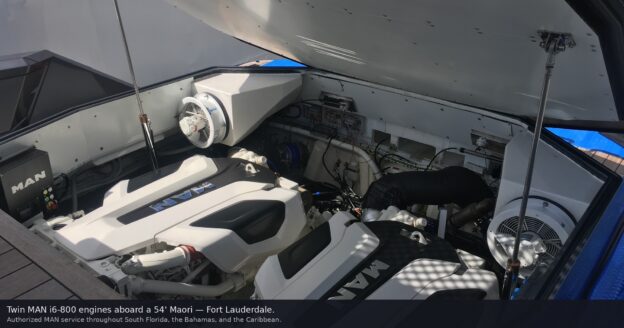
Quick answer: The MAN I6 marine diesel engine is a current-generation inline six-cylinder platform based on the D2676 base engine, introduced for marine applications at the Fort Lauderdale Boat Show in 2015. It is available in three variants — the i6-730 (537 kW / 730 HP), i6-800 (588 kW / 800 HP), and i6-850 (625 kW / 850 HP) — all sharing a 12.4-liter displacement and a common-rail fuel system with up to 1,800 bar injection pressure. These engines are designed for planing and displacement hull yachts up to 55 feet and sportfishing boats.
The MAN I6 was introduced to the marine market in the right place — the Fort Lauderdale Boat Show in 2015 — which tells you something about how MAN positioned this engine. South Florida is one of the world’s most demanding marine markets, and the Fort Lauderdale show is where serious yacht buyers and builders pay attention. The I6 platform, part of the broader MAN Engines marine lineup, had already accumulated hundreds of thousands of hours in on- and off-road commercial applications since 2007 before MAN adapted it for marine use. That proven commercial foundation is one of the things that distinguishes the I6 from purpose-built marine diesels with limited field history.
As an authorized MAN marine engine dealer in Miami, Scarano Marine services i6-730, i6-800, and i6-850 engines throughout South Florida. We’ve worked on these engines at marinas from Aventura to Key Biscayne, at boatyards along the Miami River and in Fort Lauderdale, and on vessels in the Bahamas and Caribbean. This guide covers the official specs, the real-world performance characteristics we’ve observed in this market, and the service practices that determine whether a MAN I6 reaches its full service life in South Florida’s demanding operating environment.
MAN I6 Engine — Shared Architecture and Dimensions
All three I6 variants share the same fundamental architecture, dimensions, and base engine designation (D2676 LE4xx). The differences between the i6-730, i6-800, and i6-850 are in power output and torque calibration — not in displacement, block architecture, or physical dimensions. This means parts commonality is high across the range, which simplifies service and parts stocking for owners and dealers alike.
| Engine designation | D2676 LE4xx (i6-730 / i6-800 / i6-850) |
| Engine length | 1,800 mm |
| Engine width | 922 mm |
| Engine height | 1,103 mm |
| Engine height over crankshaft | 704 mm |
| Weight (dry) | 1,215 kg |
| Cylinder arrangement | Inline, 6 cylinders |
| Bore x Stroke | 126 mm x 166 mm |
| Displacement | 12.42 liters |
| Operating mode | Four-stroke diesel engine |
| Injection system | Common Rail, up to 1,800 bar |
| Engine control unit | EDC17 |
| Direction of rotation (at flywheel) | Counterclockwise |
| Max. oblique position (axial / transverse) | 7.5° / 22.5° |
| Oil fill quantity (without / with filter) | 34 liters min / 40 liters max |
| Exhaust emissions | IMO Tier 2, RCD 2013/53/EC, EPA Tier 3, 97/68/EC |
MAN I6 Variants — Power, Torque, and Rated Speed
The three I6 variants are differentiated by rated power output and torque calibration. All share the same 2,300 rpm nominal speed. The torque plateau — a characteristic MAN feature — allows maximum torque to be sustained across a wide RPM range, which benefits both acceleration through the planing phase and fuel efficiency at cruise.
i6-730
| Rated power | 537 kW (730 HP) |
| Nominal speed | 2,300 rpm |
| Max torque | 2,450 Nm |
| Torque plateau | 1,300 – 2,100 rpm |
| Specific output | 43.2 kW/liter |
The i6-730 is the entry point of the MAN I6 range and the most appropriate choice for displacement hull applications and vessels where fuel economy and long-range cruising range are priorities over peak performance. The wide torque plateau from 1,300 to 2,100 rpm means the engine delivers strong, consistent power across the full usable RPM range — not just at the top end. In South Florida, the i6-730 is a common choice in the 42- to 50-foot trawler yacht and long-range cruiser segment.
i6-800
| Rated power | 588 kW (800 HP) |
| Nominal speed | 2,300 rpm |
| Max torque | 2,674 Nm |
| Torque plateau | 1,400 – 2,000 rpm |
| Specific output | 47.3 kW/liter |
The i6-800 is the mid-range variant and the most common MAN I6 in the South Florida market. It represents the balance point between performance and efficiency that suits the widest range of planing hull vessels in the 45- to 55-foot range. Princess Yachts, Sunseeker, and Fairline models in this size bracket frequently specify the i6-800 as standard power. The torque plateau from 1,400 to 2,000 rpm delivers strong hole shot performance and efficient cruise — two characteristics that matter in the mixed-use pattern typical of South Florida owners who run offshore to the Bahamas and back.
i6-850
| Rated power | 625 kW (850 HP) |
| Nominal speed | 2,300 rpm |
| Max torque | 2,845 Nm |
| Torque plateau | 1,400 – 2,100 rpm |
| Specific output | 50.3 kW/liter |
| Application | Light operation only |
The i6-850 is the top of the MAN I6 range and is specified for light operation applications — vessels where peak performance is the priority and operating hours are moderate. It produces 2,845 Nm of torque across the 1,400 to 2,100 rpm plateau, which translates to outstanding planing performance and strong top-end speed. In South Florida, the i6-850 appears most often in high-performance express cruisers and sportfishing boats in the 50- to 55-foot range where top speed and hole shot are priorities. Owners should be aware that the i6-850’s light operation designation means service intervals should be treated conservatively — this is the highest-stressed variant of the I6 family.
MAN I6 Common Rail System — What It Means for Performance and Service
The MAN I6’s Common Rail injection system operates at up to 1,800 bar — significantly higher than older-generation marine diesel injection systems. This high pressure allows for more precise injection timing, smaller fuel droplet size, more complete combustion, and consequently lower fuel consumption and lower emissions. The practical result is the smooth, progressive power delivery and low vibration characteristic that the I6 is known for.
For service purposes, the Common Rail system demands clean, uncontaminated fuel and genuine OEM injectors. The injection components operating at 1,800 bar have extremely tight tolerances — tolerances that are sensitive to fuel contamination, water intrusion, and off-specification fuel. In South Florida’s marine fuel environment, where fuel quality varies significantly across marinas and the warm storage conditions accelerate microbial growth, the Common Rail system is the component most at risk from deferred fuel system maintenance. A fuel filter bypass event — filter so clogged the engine pulls fuel around it — on a 1,800 bar Common Rail system causes injector damage that is expensive to repair and entirely preventable.
MAN I6 EDC17 Engine Control Unit
The MAN I6 uses the EDC17 engine control unit — the same generation of MAN engine management that governs the V8 and V12 platforms. The EDC17 controls fuel injection timing, injection quantity, turbocharger boost management, and all engine protection functions. It also stores fault codes — both active alarms and soft faults that may not trigger a warning light but indicate developing issues.
Reading EDC17 fault codes correctly, performing sensor calibrations, resetting service intervals, and programming replacement components all require MAN factory diagnostic software. This software is available only to authorized MAN dealers. It consistently identifies issues that visual inspection alone would miss, and catching soft faults early on a Common Rail engine at 1,800 bar injection pressure is significantly less expensive than addressing the damage those faults cause if left unresolved.
MAN I6 Fuel Consumption — What to Expect in the Real World
One of the reasons the MAN I6 is so popular in this market is fuel efficiency — it’s a light, powerful, quiet engine, and owners running offshore to the Bahamas and back pay close attention to burn rates. The honest answer on fuel consumption is that it depends on the vessel, the propping, how she’s loaded, the drive type, and the condition of the bottom. Published brochure figures only tell part of the story. What gives a real picture is data from the boats we actually commission and run.
On a 55-foot Azimut we commissioned out of Fort Lauderdale earlier this year, powered by twin MAN i6-850s, we logged fuel burn at every step of the rev range during sea trials. At trolling and displacement speed the engines sipped fuel — roughly 5 to 7 gallons per hour each. At an efficient cruise the figure climbed to around 16 gallons per hour per engine, and at a fast cruise the engines pulled roughly 23 to 25 gallons per hour each. Wide open, each engine reached into the low-40s gallons per hour. Those are real numbers off a real sea trial, not a brochure estimate.
What matters more than any single headline number is where the engine likes to live. The MAN I6 is most efficient through its mid-rpm band, and running her there — rather than constantly pushing wide open — is what keeps fuel bills reasonable and puts meaningful, low-stress hours on the clock. When we commission a new boat or complete a repower, we log these figures at every rpm step so the owner knows exactly what their real-world range looks like before they ever leave the dock. That is the kind of detail a brochure can’t give you, and it’s the kind of work we do on the water in South Florida every week.
MAN I6 Service Intervals — South Florida Conditions
MAN’s published service intervals are developed for standard operating conditions. South Florida’s combination of warm ambient temperatures, warm seawater, high humidity, and sustained offshore operation compresses every maintenance interval compared to the northern European climates that inform much of MAN’s published documentation. The intervals below reflect our experience servicing i6-730, i6-800, and i6-850 engines in this market.
Engine Oil and Filters
Oil and filter service every 200 operating hours or annually — whichever comes first. No exceptions. Use MAN-approved oil specification — check your engine documentation for the correct ACEA specification for your variant. Genuine MAN oil filters only.
Fuel Filters
Replace primary and secondary fuel filters at every oil service interval — 200 hours or annually. In South Florida’s fuel quality environment this is non-negotiable. After every fuel filter replacement on a Common Rail I6, the fuel system must be properly primed and bled before starting. Air introduced into a 1,800 bar Common Rail system causes misfires. This is a procedure that requires trained technician execution — it is not a self-service item.
Raw Water Impeller
Replace annually regardless of hours. South Florida’s warm, particulate-rich inshore water accelerates impeller wear beyond what the published replacement intervals assume. A failed impeller in the Gulf Stream or on a Bahamas crossing is a breakdown scenario with serious consequences. The cost of an annual impeller replacement is trivial compared to the cost of an overheated engine from a failed impeller that was left in service past its useful life — one of the clearest examples of the preventive-vs-reactive math we break down in our guide to marine diesel service cost in South Florida.
Heat Exchanger and Cooling System
Inspect at every impeller service. Full heat exchanger plate cleaning every 2 years or at any sign of elevated operating temperatures. South Florida’s warm inshore water and the biological load in marina environments accelerate scale buildup in heat exchangers significantly faster than cooler-climate operating conditions. Zinc anode replacement at every service interval — depletion rates in South Florida saltwater are higher than published schedules assume.
Air Filters
The MAN I6 uses a dry-type air filter that should be inspected annually and replaced as needed. Engine rooms in South Florida accumulate salt-laden humid air that can load air filters faster than in drier climates. A restricted air filter on a turbocharged I6 affects boost pressure, combustion efficiency, and fuel consumption. It also generates EDC17 fault codes that can be misdiagnosed as turbocharger or injection system faults if the simple filter check is skipped.
MAN I6 in South Florida — What We See in the Field
The MAN I6 platform has been in South Florida’s marine market for a decade now, and the patterns in how these engines age are clear. The engines that perform best — the ones approaching 5,000 to 6,000 hours with clean diagnostic histories and no major component failures — share a common profile, and it lines up exactly with what we cover in our guide on how to extend marine diesel engine life in South Florida: consistent 200-hour service intervals from new, genuine OEM parts throughout their lives, and annual EDC17 diagnostic scans that caught soft faults early.
The engines that fail early share a different profile: extended oil change intervals, deferred fuel filter service, impellers run past their useful life, and no diagnostic scanning until an active alarm appears. We’ve repaired i6-800 engines in Fort Lauderdale and Miami that needed injector replacement at under 1,500 hours — a failure that traces directly to fuel contamination from a filter that was left in service too long. The Common Rail system at 1,800 bar does not forgive fuel system neglect.
The i6-850 in particular deserves attention from owners in terms of service discipline. Its light operation designation means it’s producing more stress per hour than the 730 or 800 variants, and the service schedule needs to reflect that. We recommend treating the i6-850 to the same disciplined maintenance approach as a high-output V8 rather than treating it as a standard I6 simply because it shares the same engine architecture.
The I6’s commercial roots aren’t just a talking point for us — we’ve worked on this platform in heavy-duty service firsthand. We repowered a commercial tugboat in the Bahamas, replacing aging Detroit Diesel power with the commercial MAN I6 (D2676) platform. A tug runs a continuous-duty rating, worlds apart from the light-operation pleasure-craft variants, and seeing the same base engine perform reliably under that kind of sustained commercial load tells you everything about the platform’s durability. It’s the same engineering foundation under the i6-730, i6-800, and i6-850 in the yachts and sportfishers we service every week.
MAN I6 vs MAN V8 — The Right Choice for Your Vessel
The most common question from owners choosing between the MAN I6 and V8 platforms for a vessel in the 45- to 60-foot range comes down to the same factors we address in our MAN V8 marine diesel engine guide: performance priorities, engine room space, and intended use pattern.
The I6’s inline configuration gives it a meaningful package size advantage — at 922 mm wide, it is significantly narrower than the V8, which matters in engine rooms where cross-engine service access is limited. The I6 also has a lower dry weight at 1,215 kg versus the V8’s heavier package, which affects performance particularly in lighter-displacement hulls. For vessels in the 42- to 55-foot range used primarily for extended cruising, island hopping, and offshore passages, the I6’s fuel efficiency at cruise and its compact dimensions make it the stronger practical choice. For vessels where WOT performance and maximum horsepower are the priority — tournament sportfishers, high-speed express cruisers — the V8’s higher output ceiling is the relevant advantage, and for the largest, fastest yachts the discussion moves up to the MAN V12 marine diesel engine guide.
Frequently Asked Questions: MAN I6 Marine Diesel Engine
What are the MAN I6 marine diesel engine variants?
The MAN I6 marine diesel engine is available in three variants: the i6-730 (537 kW / 730 HP), i6-800 (588 kW / 800 HP), and i6-850 (625 kW / 850 HP). All three share the same D2676 base engine, 12.4-liter displacement, and physical dimensions (1,800 x 922 x 1,103 mm). They differ in rated power output and torque calibration. The i6-850 is rated for light operation only.
When was the MAN I6 marine engine introduced?
MAN introduced the I6 marine engine at the Fort Lauderdale International Boat Show in 2015. The base engine (D2676) had been in commercial on- and off-road use since 2007, accumulating hundreds of thousands of hours of field experience before its marine adaptation. This proven commercial foundation is one of the MAN I6’s key credibility points as a marine platform.
What is the MAN I6 injection system pressure?
The MAN I6 uses a Common Rail injection system operating at up to 1,800 bar. This high injection pressure enables precise fuel atomization, more complete combustion, lower fuel consumption, and reduced emissions. It also means the fuel system is highly sensitive to contamination — genuine OEM fuel filters replaced at correct intervals are essential to protect the injection components.
What vessels use MAN I6 engines in South Florida?
The MAN I6 is common in planing and displacement hull yachts up to 55 feet and sportfishing boats in South Florida. Princess Yachts, Sunseeker, and Fairline models in the 42- to 55-foot range frequently use twin i6-800 engines as standard power. The i6-730 appears in displacement and semi-displacement hull cruisers, and the i6-850 in higher-performance express cruiser and sportfishing applications.
How much fuel does a MAN I6 burn?
It varies with the vessel, propping, drive type, and load, but real numbers from our own sea trials give a reliable picture. On a 55-foot Azimut we commissioned out of Fort Lauderdale with twin MAN i6-850s, the engines burned roughly 16 gallons per hour per engine at an efficient cruise and around 23 to 25 gallons per hour per engine at a fast cruise, climbing into the low-40s gallons per hour at wide-open throttle. The MAN I6 is most efficient in its mid-rpm range, which is where we recommend owners spend most of their time for the best balance of speed, range, and engine longevity.
How often should a MAN I6 be serviced in South Florida?
Oil and filter changes every 200 hours or annually, raw water impeller replacement annually, heat exchanger inspection at every impeller service with plate cleaning every 2 years, zinc anodes at every service, and an EDC17 diagnostic scan at every major service interval. South Florida’s warm water and operating conditions compress these intervals compared to published schedules designed for cooler-climate conditions.
Does Scarano Marine service MAN I6 engines?
Yes. Scarano Marine is an authorized MAN marine engine dealer in Miami providing factory-certified service for MAN I6 engines — i6-730, i6-800, and i6-850 — throughout South Florida, the Bahamas, and the Caribbean. We perform routine maintenance, EDC17 diagnostics, fault code resolution, warranty work, and major repairs on the I6 platform dockside at marinas, boatyards, and private docks from Palm Beach to Key Biscayne.
Disclaimer: This article is provided for general informational and educational purposes only and does not constitute professional, technical, or mechanical advice. Engine specifications are sourced from MAN Engines published documentation for the D2676 LE4xx marine engine series and are subject to change by the manufacturer without notice; Scarano Marine Inc. does not warrant their current accuracy or completeness. Service intervals reflect Scarano Marine Inc.’s experience with MAN I6 engines in South Florida operating conditions and may differ from manufacturer-published intervals. Fuel consumption figures are real-world estimates that vary with vessel hull form, propeller configuration, load, sea conditions, and engine condition, and should not be relied upon for range or operational planning. Every vessel and engine installation is different; nothing in this article should be acted upon without inspection and guidance from a qualified, authorized service technician familiar with your specific vessel. Reading this article does not create a service, dealer, or professional relationship between you and Scarano Marine Inc. To the fullest extent permitted by law, Scarano Marine Inc. disclaims all liability for any loss, damage, or expense arising from reliance on the information contained herein. Scarano Marine Inc. is an authorized MAN marine engine dealer. | Full disclaimer