


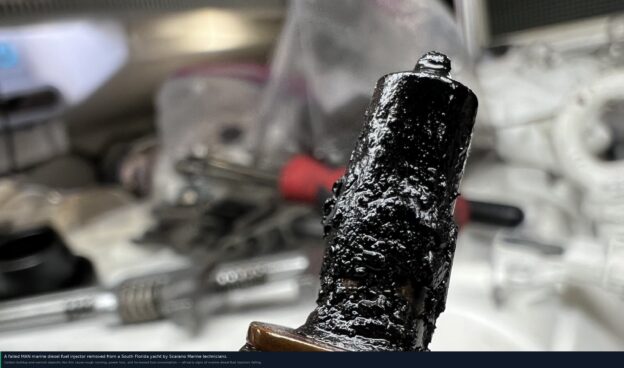
How to Tell If Your Marine Diesel Fuel Injectors Are Failing
Marine diesel fuel injectors failing produce six consistent warning signs: rough running at idle, hesitation or surging under load, increased fuel consumption, loss of power that worsens gradually, excessive exhaust discoloration, and in advanced cases, misfiring or hard starting. Catching these signs early is the difference between a $300 injector cleaning and a $3,000 injector replacement — or worse, piston damage from fuel washing the cylinder walls.
In South Florida, marine diesel fuel injectors fail faster than in cooler climates. The combination of heat-accelerated fuel degradation, water contamination from condensation in high-humidity conditions, and the microbial growth that thrives in warm diesel tanks creates conditions that stress injectors year-round. After more than 30 years in this industry and thousands of service calls across Fort Lauderdale, Miami, and the Bahamas, I can tell you that injector problems are one of the most consistently misdiagnosed issues we see — because the early symptoms look like a dozen other things.
This guide walks through every warning sign of marine diesel fuel injectors failing, how to distinguish injector problems from other common causes, what the diagnosis and repair process looks like, and what it costs at different stages of severity.
Why Marine Diesel Fuel Injectors Fail Faster in South Florida
Understanding why marine diesel fuel injectors fail in South Florida requires understanding what injectors actually do. A modern common rail injector on a MAN marine diesel opens and closes up to 2,000 times per minute, delivering precisely metered fuel at pressures up to 1,800 bar through an orifice smaller than a human hair. The tolerances involved are extraordinary — and those tolerances are what South Florida’s fuel and heat conditions attack.
Three South Florida-specific factors accelerate injector wear:
- Water contamination from condensation: South Florida’s extreme humidity accelerates moisture accumulation in diesel tanks — particularly on vessels that sit between outings. Water passing through injectors causes corrosion and accelerates wear on the precision internal components. Even small amounts of water in the fuel system can cause injector damage over time.
- Microbial contamination — diesel bug: South Florida’s warm temperatures are ideal for microbial growth in diesel tanks. The byproducts of this growth — commonly known as diesel bug — clog injector filters and deposit varnish on injector needles, reducing spray quality and eventually causing sticking. This is one of the most common root causes of marine diesel fuel injectors failing that we see in Fort Lauderdale and Miami.
- Heat-accelerated fuel degradation: Diesel fuel sitting in tanks exposed to South Florida’s intense sun degrades and forms gum and varnish deposits faster than in cooler climates. These deposits accumulate on injector components over time, progressively degrading spray pattern and delivery volume.
The result: marine diesel fuel injectors that would last 3,000–4,000 hours in a cooler climate may start showing symptoms in 1,500–2,000 hours in South Florida conditions — sometimes less, depending on fuel quality and maintenance discipline.
6 Warning Signs of Marine Diesel Fuel Injectors Failing

1. Rough running or uneven idle
A healthy marine diesel idles smoothly and evenly. When one or more injectors begin failing — delivering incorrect fuel volumes or poor spray patterns — the engine runs unevenly at idle. You’ll feel it as a slight shake or vibration that wasn’t there before, and hear it as an uneven exhaust note.
This is often the first sign of marine diesel fuel injectors failing, and the one most owners dismiss as normal engine behavior. It isn’t. An engine that idles differently than it did six months ago is telling you something.
- What it feels like: Vibration at idle that improves at higher RPM, uneven exhaust sound, slight hesitation when throttling up from idle.
- Urgency: Low to medium — worth investigating at the next service but not an immediate stop-the-boat situation unless it worsens.
2. Loss of power that develops gradually
Failing injectors deliver less fuel or fuel in a poor spray pattern that doesn’t combust efficiently. The result is a gradual reduction in power output that develops slowly enough that many owners don’t notice it until it’s significant. By the time you’re obviously down on power, injector wear is usually well advanced.
In South Florida’s heat — where engines are already operating with reduced air density — the power loss from failing injectors compounds with heat-related de-rating. Owners often attribute the combination to summer conditions rather than a developing mechanical problem.
- What it feels like: Can’t reach previous top speed, reduced acceleration, engine feels flat under load.
- Urgency: Medium — schedule a diagnostic scan. For MAN engines this requires factory-level EMS access to read injector-specific fault codes.
3. Increased fuel consumption
When injectors wear, they often deliver more fuel than required — or deliver fuel in a pattern that doesn’t combust completely. Either way, you burn more diesel for the same output. In our Fort Lauderdale and Miami service records, a 15–25% increase in fuel consumption is a consistent early indicator of marine diesel fuel injectors failing before other symptoms become obvious.
- What it feels like: Filling up more often than usual for the same routes, range dropping noticeably on offshore passages.
- Urgency: Medium — track fuel consumption over several outings and compare against your historical baseline. A consistent 15%+ increase warrants a diagnostic.
4. Exhaust discoloration — white or black
Failing injectors produce exhaust discoloration in two directions depending on the failure mode. Injectors delivering too much fuel produce black exhaust — incomplete combustion creating soot. Injectors with poor spray patterns produce white or grey exhaust — unburned fuel passing through the cylinder. Both are signs of marine diesel fuel injectors failing.
If you’ve read our article on exhaust discoloration from a marine diesel engine, you’ll know that white exhaust has multiple possible causes. When injectors are the culprit, it’s typically accompanied by a fuel smell rather than a sweet coolant smell — which helps distinguish it from head gasket issues.
- What it looks like: Black exhaust under acceleration, white or grey exhaust at cruise, stronger than normal fuel smell from the exhaust.
- Urgency: Medium to high — exhaust discoloration from injector issues indicates the problem is affecting combustion quality.
5. Hesitation, surging, or rough running under load
As injectors deteriorate further, the uneven fuel delivery becomes apparent under load. Acceleration hesitation — where the engine stumbles before pulling — and surging at cruise RPM are both classic signs of marine diesel fuel injectors failing in a way that’s disrupting the combustion cycle.
On MAN engines with the electronic management system, this often generates fault codes that only factory-level diagnostic software can read. Generic diagnostic tools may show no codes at all even when the injector performance is measurably degraded — which is exactly why MAN dealer diagnostic access matters for accurate diagnosis.
- What it feels like: Stumbling or hesitation when throttling up, surging at constant RPM, rough running that worsens under load.
- Urgency: High — schedule a diagnostic scan immediately. Running with compromised combustion accelerates wear on pistons and cylinder walls.
6. Hard starting or misfiring
In advanced injector failure, the engine becomes difficult to start — particularly after sitting — because the injectors can’t deliver sufficient fuel for initial combustion. Misfiring at low RPM is also common at this stage. By the time you’re experiencing hard starting from injector problems, the injectors are well beyond the point where cleaning will help and replacement is the only solution.
- What it feels like: Slow or labored cranking before the engine fires, misfiring at idle, engine stopping unexpectedly at low RPM.
- Urgency: High — the engine should not be run offshore in this condition. Schedule immediate service.
How Marine Diesel Fuel Injectors Are Properly Diagnosed
Proper diagnosis of marine diesel fuel injectors failing requires more than a visual inspection or a generic fault code reader. Here is the process our Fort Lauderdale and Miami technicians use:
- EMS diagnostic scan: On MAN engines, factory-level diagnostic software reads injector-specific performance data — delivery volume, timing, and return flow — for each cylinder individually. This identifies which injectors are underperforming and by how much before any physical work is done.
- Injector return flow test: Measures how much fuel leaks back through each injector. High return flow indicates worn injector needle seats — a reliable indicator of when cleaning will help versus when replacement is necessary.
- Fuel pressure testing: Verifies that the common rail is maintaining correct fuel pressure. Low rail pressure can mimic injector symptoms and needs to be ruled out before injector work begins.
- Fuel sample analysis: A sample sent for spectrographic testing identifies water content, microbial contamination, and fuel degradation — the root causes of injector wear in South Florida’s heat and humidity.
For full MAN marine engine specifications and technical documentation, visit MAN Yacht Engines.
Repair Options and Costs for Marine Diesel Fuel Injectors Failing
The right repair depends entirely on how far the injector degradation has progressed. Here is the full spectrum:
Injector cleaning and testing ($150–$400 per injector)
When injectors are fouled with varnish or microbial deposits but the internal components are not worn beyond spec, ultrasonic cleaning and flow bench testing can restore performance. This is the right option for early-stage injector problems — caught through the warning signs described above before significant wear has occurred. Genuine MAN injector cleaning uses the manufacturer’s own procedures and spec thresholds, which differ from generic cleaning services.
Injector replacement ($400–$3,000 per injector)
When injector wear has progressed beyond what cleaning can address — confirmed by return flow testing — replacement is the only effective solution. On a typical MAN V8 or V10 yacht engine, replacing all injectors runs $3,200–$7,200 in parts alone using genuine OEM components.
Downstream damage repair ($3,000–$8,000+)
When marine diesel fuel injectors fail completely — particularly those that stick open and flood cylinders with raw fuel — the resulting fuel washing of cylinder walls accelerates piston ring and cylinder liner wear. In severe cases, hydraulic lock occurs when liquid fuel accumulates in a cylinder and the piston cannot complete its stroke. Catching injector problems at the first warning signs is what prevents this tier of damage entirely.
Why Fort Lauderdale and Miami Yacht Owners Call Scarano Marine for Injector Service
Diagnosing marine diesel fuel injectors failing accurately requires factory-level diagnostic tools that generic shops simply don’t have. On MAN engines specifically, our factory-certified technicians use MAN’s proprietary diagnostic software to read cylinder-by-cylinder injector performance data — identifying exactly which injectors are underperforming and by how much. That precision prevents unnecessary parts replacement and ensures the repair addresses the actual problem.
Our founder Adolfo Scarano spent 30 years in the diesel engine world — including as service manager for an MTU distributor and factory certification at MTU’s headquarters in Friedrichshafen, Germany — before founding Scarano Marine in 2007. Our Fort Lauderdale and Miami teams work on MAN marine diesel engines approximately 90% of the time. That depth of experience on a single engine family means we’ve seen every injector failure mode these engines can produce — and we recognize them early.
Our mobile field service covers all of South Florida — Fort Lauderdale, Miami, Palm Beach, and the Florida Keys — and we regularly travel to the Bahamas, Caribbean, and Central America. For injector diagnostic scans and fuel system testing, our mobile technicians carry the same factory equipment as our workshop locations.
Frequently Asked Questions: Marine Diesel Fuel Injectors Failing
How long do marine diesel fuel injectors last in South Florida conditions?
In cooler climates with good fuel quality, MAN marine diesel injectors typically last 3,000–4,000 hours before requiring attention. In South Florida conditions — with higher ambient temperatures, humidity-driven water contamination in diesel tanks, and the microbial growth common in warm fuel — expect to see early symptoms of marine diesel fuel injectors failing at 1,500–2,000 hours, sometimes less. Annual injector testing as part of your service schedule is the most cost-effective approach.
Can I clean marine diesel fuel injectors myself?
Fuel additive treatments sold at marine stores have limited effectiveness on modern common rail injectors and no effectiveness on injectors with mechanical wear. Proper injector cleaning requires ultrasonic equipment and flow bench testing to verify the result. Attempting DIY injector removal on a MAN common rail engine without the proper tools and training risks damaging the high-pressure fuel system — repairs for which run significantly more than professional injector service. For MAN engines specifically, dealer-level service is the only way to confirm injector performance to manufacturer specifications.
What causes marine diesel fuel injectors to fail prematurely in South Florida?
The three most common causes of premature marine diesel fuel injectors failing in South Florida are water contamination from condensation in the region’s high-humidity environment, microbial growth in warm diesel tanks producing varnish and sludge deposits on injector components, and heat-accelerated fuel degradation creating gum deposits. All three are preventable with regular fuel sample testing, biocide treatment, water separator maintenance, and annual injector testing as part of your service schedule.
Does Scarano Marine offer mobile injector diagnostic service in Fort Lauderdale, Miami, and the Bahamas?
Yes. Our mobile field service teams carry MAN factory diagnostic equipment including the software required for cylinder-by-cylinder injector performance scanning. We can perform full injector diagnostics, fuel pressure testing, and fuel sample collection at your dock or marina anywhere in South Florida — and we regularly dispatch to the Bahamas, Caribbean, and Central America. Contact our Fort Lauderdale or Miami office to schedule.
Noticing Any of These Warning Signs? Don’t Wait.
Marine diesel fuel injectors failing caught early costs hundreds. Caught late, it costs thousands — and potentially a ruined engine offshore. Scarano Marine’s factory-certified teams in Fort Lauderdale and Miami carry the diagnostic tools and genuine MAN OEM parts to identify and resolve injector problems at any stage. Contact us today for a diagnostic visit at your dock or at our Fort Lauderdale or Miami facility.
The information on this site is for general informational purposes only and does not constitute professional marine engineering advice. Cost estimates are not quotes. Never make repair, operational, or financial decisions based solely on content found on this website. Scarano Marine Inc accepts no liability for damages arising from reliance on this content. Full Disclaimer