


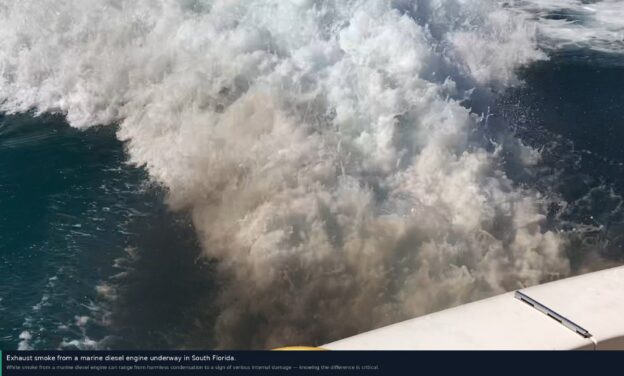
White Smoke From a Marine Diesel Engine — Causes, Diagnosis and Repair in South Florida
White smoke from a marine diesel engine is most commonly caused by one of five things: coolant entering the combustion chamber from a failing head gasket, unburned fuel from injector problems or low compression, a cold engine that hasn’t reached operating temperature, water ingestion through the exhaust system, or a cracked cylinder head. The cause determines the urgency — some white smoke is harmless and temporary, and some is a warning that the engine needs to come out of service immediately.
White smoke from a marine diesel engine is one of the calls our Fort Lauderdale and Miami teams get most frequently — and one where getting the diagnosis right matters enormously. Misread it and you either pull a perfectly functional engine for unnecessary repairs, or you keep running an engine that’s quietly destroying itself. After more than 30 years in this industry, I’ve learned that the color, timing, and smell of the smoke tells most of the story before you even open the engine hatch.
This guide walks through the five most common causes of white smoke in marine diesels, how to distinguish between them, what the repair costs look like, and when you need a certified technician rather than a DIY fix.
Not All White Smoke From a Marine Diesel Engine Means the Same Thing
Before diagnosing white smoke from a marine diesel engine, it helps to understand that white smoke is actually a catch-all description for several different phenomena that look similar but have completely different causes and consequences.
Steam is white and disappears quickly — it’s usually harmless condensation on a cold engine burning off at startup. True white smoke is denser, lingers in the air, and often has a distinct smell — either sweet (coolant) or oily/fuel-like (unburned diesel). Knowing which you’re looking at before you start diagnosing saves significant time and prevents unnecessary teardowns.
The three questions to ask when you see white smoke from your marine diesel:
- When does it appear? Only at cold startup, or continuously once the engine is warm?
- What does it smell like? Sweet and antifreeze-like, or raw diesel fuel?
- What else is happening? Coolant level dropping, oil looking milky, overheating, loss of power?
The answers narrow the diagnosis considerably before you’ve touched a single component.
5 Proven Causes of White Smoke From a Marine Diesel Engine
1. Head gasket failure — the most serious cause
When a head gasket begins to fail, coolant leaks into the combustion chamber and burns off as white smoke — typically sweet-smelling and continuous once the engine reaches operating temperature. This is the white smoke scenario that demands immediate action. Continuing to run the engine accelerates the damage exponentially and can turn a $2,000–$4,000 head gasket repair into a $60,000–$100,000 engine overhaul.
In South Florida’s heat, head gaskets on high-hour engines are more vulnerable than in cooler climates — sustained thermal stress over thousands of hours weakens the gasket material in ways that show up first as white smoke from a marine diesel engine under load.
- Key identifiers: Sweet-smelling white smoke, coolant level dropping between outings, oil appearing milky or frothy on the dipstick, overheating, bubbles in the coolant reservoir.
- Urgency: High — stop running the engine and call a certified technician immediately.
- Typical repair cost: $2,000–$4,000 for head gasket replacement. $6,000–$10,000 if the head is warped and requires machining or replacement.
2. Injector problems — unburned fuel
Fuel injectors that are worn, partially blocked, or delivering incorrect spray patterns produce white or light grey smoke because fuel isn’t burning completely in the combustion chamber. In South Florida’s heat, microbial contamination in tanks accelerate injector wear compared to cooler climates — it’s one of the most common sources of white smoke from a marine diesel engine we see in Fort Lauderdale and Miami.
- Key identifiers: White or light grey smoke with a fuel smell, rough idle, hesitation under load, increased fuel consumption.
- Urgency: Medium — the engine can continue operating but injector problems worsen over time and can damage pistons if left unaddressed.
3. Cold engine startup — usually harmless
White steam or smoke at cold startup — especially in the early morning in Fort Lauderdale or Miami — is usually condensation in the exhaust system burning off as the engine reaches operating temperature. This is normal and typically clears within 2-3 minutes of running.
The key distinction: cold startup white smoke clears as the engine warms. If white smoke from your marine diesel engine persists beyond the first few minutes of operation or appears when the engine is already at operating temperature, it is not condensation and needs investigation.
- Key identifiers: Appears only at cold start, clears within minutes, no smell, coolant and oil levels normal.
- Urgency: Low — monitor and confirm it clears fully within 3-5 minutes.
- Action: None required if it consistently clears. If it takes longer to clear over time, have the engine inspected.
4. Low compression — worn engine internals
When cylinder compression drops below specification — due to worn piston rings, valve wear, or cylinder wall wear — fuel doesn’t burn completely and exits as white or grey smoke. Low compression white smoke from a marine diesel engine is common on high-hour engines and is often accompanied by a gradual loss of power over time.
This is the cause that tends to sneak up on owners. It develops slowly and the smoke is often intermittent at first — enough that owners attribute it to other causes and defer diagnosis. By the time compression loss is obvious from the helm, significant internal wear has usually already occurred.
- Key identifiers: White or grey smoke that worsens under load, gradual power loss, hard starting, high oil consumption.
- Urgency: Medium to high depending on compression readings — requires a proper compression test to assess.
5. Water ingestion through the exhaust — a South Florida specific risk
Wet exhaust systems on marine diesels can allow seawater to siphon back into the exhaust manifold or engine when the vessel is at rest or the anti-siphon valve fails. When that water burns off on startup, it produces white smoke. This is particularly relevant in South Florida where vessels sit in marina slips for extended periods and where the combination of tidal movement and aging anti-siphon valves creates a risk that owners in cooler, calmer anchorages don’t face at the same frequency.
In severe cases — where significant water has entered the cylinders — starting the engine can cause hydrolocking, which bends connecting rods and destroys the engine instantly. If you suspect water has entered the cylinders, do not attempt to start the engine before having a technician inspect it.
- Key identifiers: White smoke specifically at startup after the vessel has been sitting, water visible in exhaust, hard or sluggish cranking.
- Urgency: High — do not start the engine if you suspect significant water ingestion.
How to Diagnose White Smoke From a Marine Diesel Engine in South Florida
Here is the systematic approach our Fort Lauderdale and Miami technicians use when a white smoke marine diesel engine call comes in — adapted for what an owner can assess before calling for service:
- Step 1 — Check coolant and oil: Before anything else, check coolant level and oil condition. Milky oil or a dropping coolant level points directly to head gasket failure — stop and call a technician.
- Step 2 — Time the smoke: Does it clear within 3-5 minutes of startup? If yes, likely condensation. If it persists or appears when the engine is warm, proceed to further diagnosis.
- Step 3 — Smell the smoke: Sweet smell indicates coolant. Fuel smell indicates injector or compression issues. No distinct smell on persistent white smoke — check for water ingestion.
- Step 4 — Check exhaust for water: If the vessel has been sitting, inspect the exhaust outlet and check the anti-siphon valve before starting.
- Step 5 — Call a certified technician: For anything beyond condensation, proper diagnosis requires a compression test, EMS diagnostic scan, and in some cases a coolant pressure test. These are dealer-level tools — not guesswork.
For full MAN yacht engine specifications and technical documentation, visit MAN Yacht Engines.
Why Fort Lauderdale and Miami Yacht Owners Call Scarano Marine First
White smoke from a marine diesel engine is one of those symptoms where experience matters more than equipment. Our founder Adolfo Scarano built Scarano Marine after 30 years in the diesel engine world — including as service manager for an MTU distributor and factory certification in Germany — specifically because he saw how often misdiagnosis led to unnecessary repairs or missed the real problem entirely.
Our Fort Lauderdale and Miami teams work on MAN marine diesel engines approximately 90% of the time. That repetition on a single engine family builds the kind of pattern recognition that catches a developing head gasket before it becomes a cracked head, or identifies an injector issue from the character of the smoke before a single instrument confirms it. Factory-certified technicians with genuine MAN diagnostic software and direct access to MAN’s engineering team — that’s what you get when you call Scarano Marine.
Our mobile field service covers all of South Florida — Fort Lauderdale, Miami, Palm Beach, the Florida Keys — and we regularly travel to the Bahamas, Caribbean, and Central America for clients on extended voyages. If your engine is producing white smoke offshore, call us before you make a decision that could cost you significantly more than the repair.
Frequently Asked Questions: White Smoke From a Marine Diesel Engine
Is white smoke from a marine diesel engine always serious?
Not always. White smoke from a marine diesel engine at cold startup that clears within a few minutes is usually condensation burning off and is generally harmless. However, white smoke that persists once the engine is warm, appears continuously, has a sweet or fuel smell, or is accompanied by coolant loss or milky oil is always serious and requires immediate diagnosis. When in doubt, shut down and call a technician — the cost of an unnecessary inspection is always less than the cost of a failed head gasket.
What does white smoke from a marine diesel engine smell like?
The smell is one of the most useful diagnostic clues. Sweet-smelling white smoke — similar to antifreeze — almost always indicates coolant entering the combustion chamber, which points to a head gasket failure or cracked head. White smoke with a raw fuel smell indicates unburned diesel, typically from injector problems or low compression. White smoke with no distinct smell that appears specifically at startup may be water ingestion through the exhaust system. Odorless white smoke that clears quickly on a cold engine is usually condensation.
Can I keep running my marine diesel if it’s producing white smoke?
It depends on the cause. Cold startup steam that clears quickly — yes. Any other form of white smoke from a marine diesel engine — proceed with extreme caution and get a diagnosis before continuing. Running an engine with a failing head gasket or water in the cylinders can turn a $3,000 repair into a $75,000 engine replacement within a single outing. If you’re offshore and the white smoke starts, reduce load, monitor temperatures closely, and head for the nearest port.
Does Scarano Marine offer mobile service for white smoke diagnosis in Fort Lauderdale, Miami, and the Bahamas?
Yes. Our mobile field service teams operate throughout South Florida — Fort Lauderdale, Miami, Palm Beach, and the Florida Keys — and regularly travel to the Bahamas, Caribbean, and Central America. Our mobile technicians carry compression testing equipment, MAN factory diagnostic software, coolant pressure testing tools, and genuine OEM parts. Most white smoke diagnoses can be completed at your dock without hauling out. Contact our Fort Lauderdale or Miami office to schedule.
White Smoke From Your Marine Diesel? Call Us Before You Start It Again.
White smoke from a marine diesel engine ranges from completely harmless to the early warning of a catastrophic failure — and the difference between those two outcomes is usually a phone call made before the next outing rather than after it. Scarano Marine’s factory-certified teams in Fort Lauderdale and Miami are available for mobile diagnosis, dockside repair, and full overhauls. Contact us today and let’s find out what your engine is telling you.
The information on this site is for general informational purposes only and does not constitute professional marine engineering advice. Cost estimates are not quotes. Never make repair, operational, or financial decisions based solely on content found on this website. Scarano Marine Inc accepts no liability for damages arising from reliance on this content.
Full Disclaimer